
Hey, what’s going on out there? Welcome back into the studio. If you’ve ever sat in front of your monitors as a beginner and wondered, “Why is my bass so close, but it just isn’t hitting quite the same way as my favorite records?”… you aren’t alone. Getting the low end right is the ultimate balancing act.
Today, we’re going to break down three essential sub-bass and 808 mixing tips that will give you that extra 5 to 10% you need to truly compete in today’s landscape. These are the tricks that trigger those “aha moments” in the studio. Let’s get started.
1. Feel the Magic with Little Labs VOG (Voice of God)
If your kick and bass are almost there but just need a little more sub-frequency content to push them over the edge, you need a bass resonance tool. The Little Labs VOG plugin does something absolutely magic to the low end.
Instead of just turning up a standard low-shelf EQ, this tool targets and focuses the energy, generating subharmonics that you can actually feel.
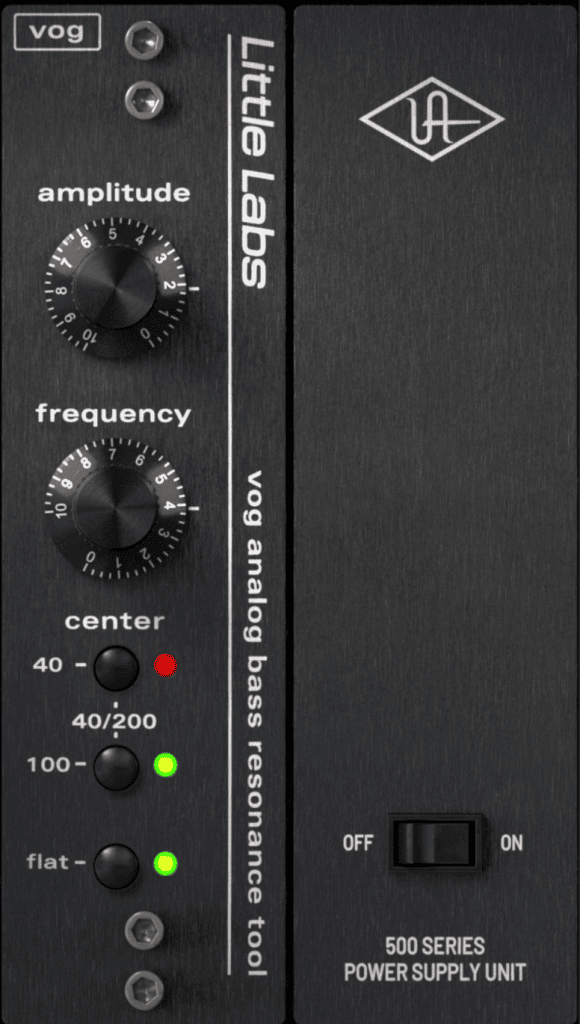
A quick note for the “stock plugin” purists: You’ll inevitably hear some engineers say, “Any stock EQ and basic saturator can do the same thing by placing a resonant bump at the cutoff and adding saturation.”
Technically? You could make that “under-the-hood” argument about almost any specialty plugin on the market. But in a fast-paced session, we’re mixing with momentum. If you have to stop your creative flow, pull up an EQ, calculate a precise resonant peak, route a parallel saturation aux, and blend them just to get an 808 to sit right, you’ve killed the flow. VOG is about how the process feels and how quickly you get the desired sound. Two knobs 🤌
A quick warning: You cannot mix subharmonics on phone speakers. Put on your best open-back headphones, or better yet, fire up your studio monitors and subwoofer. This plugin can do some dangerous things to your bass levels if you aren’t paying attention, so dial it in at a low amplitude. It’s the perfect tool to squeeze that extra bit of impact out of your kicks and subs.
2. Visualize Your Low End with Tonal Balance Control 3
Sometimes the biggest issue isn’t your technique; it’s your room. If you simply can’t hear what’s going on in the sub-frequencies, you need a visual representation.
iZotope’s Tonal Balance Control 3 is a lifesaver. You can route any reference track you love straight into it (whether from Spotify or a file) and it will capture a full-spectrum analysis of what is happening frequency-wise.
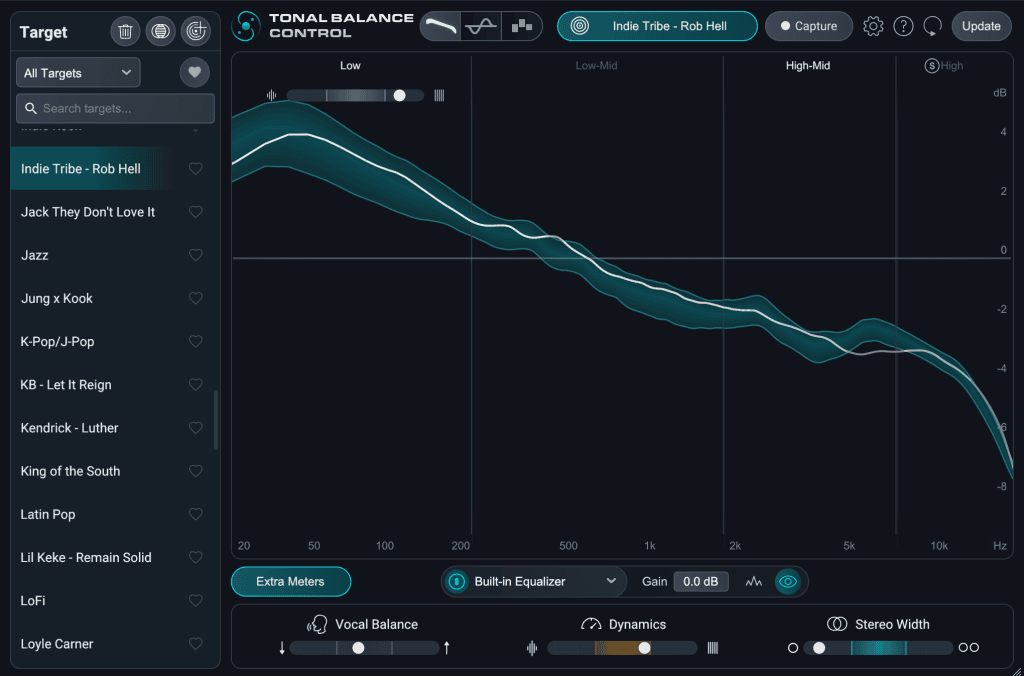
The goal isn’t to match your reference curve exactly. Instead, it gives you a reliable target range. It shows you immediately if your 808s are getting overly loud and reckless, or if they lack the impact needed to stand up next to commercial releases.
3. The Linear Phase EQ Isolation Trick for Better 808 Mixing
If you don’t have a treated room or a subwoofer, this is a massive hack for monitoring exactly what your low end is doing.
Take a Linear Phase EQ (the stock one in Logic works perfectly) and set up a steep roll-off from 100Hz and below. Here is the crucial part: place this EQ after your limiter or maximizer.
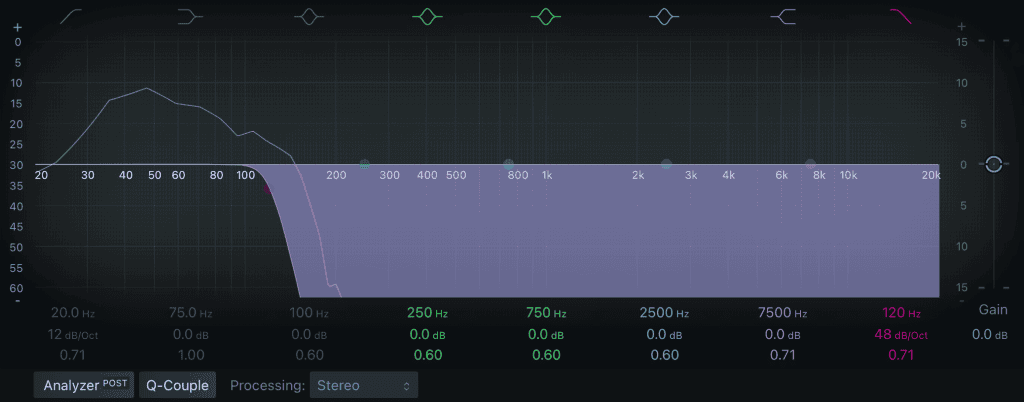
When you turn it on, you will hear absolutely nothing but the sub-frequencies, exactly as they will sound when they leave your DAW. Often, you’ll notice that the sub is actually causing your mix to clip post-limiter. When you isolate the bass this way, you can clearly hear if there is unwanted distortion down there, allowing you to back off the input level to your limiter or turn on True Peak to tame it and keep things clean.
Bonus: The “Controversial” Mix Bus High-Pass
A lot of engineers will tell you to never use a high-pass filter on your stereo mix bus. I disagree — with an asterisk. You shouldn’t use just any high-pass filter, but the right one can tighten everything up beautifully.
Most standard high-pass filters start cutting around 30Hz or 40Hz, which is often too high and kills your impact. But if you use a high-quality EQ like the Manley Massive Passive, you can set a high-pass filter all the way down at 23Hz (or even 12Hz).
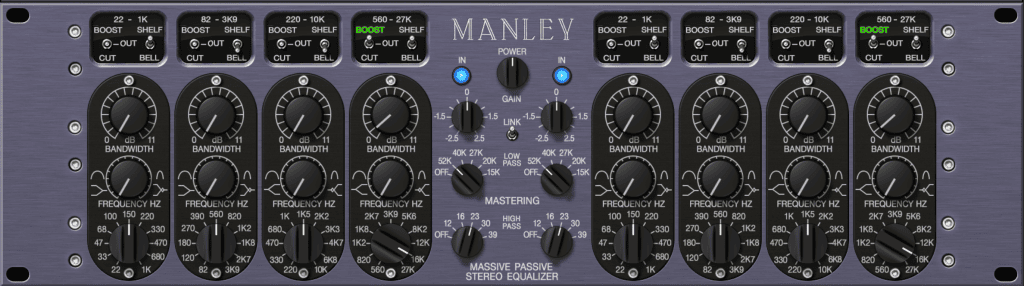
Rolling off that extreme, inaudible rumble cleans up your mix bus. You don’t lose the impact; you just get a noticeably tighter, punchier low end.
Getting massive hip-hop 808s to sit perfectly next to a lead vocal without wrecking the rest of your session is tough. But if you start applying these tools to map, control, and enhance your low end, you’re going to notice a huge difference in your mixes.
Hope this was helpful for y’all. Stay blessed!