
What’s going on out there? I hope you’re doing well!
The other day, I got a message over on Instagram asking a question I hear a lot: What’s the actual difference between a clipper and a limiter? Along with that, a few of you asked if you can get away with not using limiters at all on your master bus. What’s going to give you the absolute best results for your sessions?
I wanted to break it all down for you today, the exact reasoning behind why you’d pick one over the other, the different sonic effects you’ll get, and my personal favorite way to set up my master chain.
Let’s dive in!
The Core Difference: Distortion vs. Compression
Before we look at the plugins, let’s keep it real simple:
- Clipping = Distortion
- Limiting = Compression
They sound totally different, they act totally different, and they serve distinct purposes in your mix.
1. The Audio Clipper (Kazrog KClip)
One of my absolute favorite clippers to use on the master bus is KClip by Kazrog.
What a clipper does is very straightforward: once your audio signal goes above a set threshold, it literally chops off the extreme peaks. If you have loud, punchy drums, heavy 808s, or sharp vocal transients, those spikes get shaved flat so they sonically can’t cross that line.
The actual sonic effect you get from this chopping is distortion.
When you drive a mix into a single-band clipper, it gives you a raw, punchy, aggressive tone. That gritty low end on a kick or 808 can sound awesome for hip-hop or trap, but it can also sound unprofessional and abrasive if you aren’t careful.
My Go-To Trick: Multi-Band Clipping
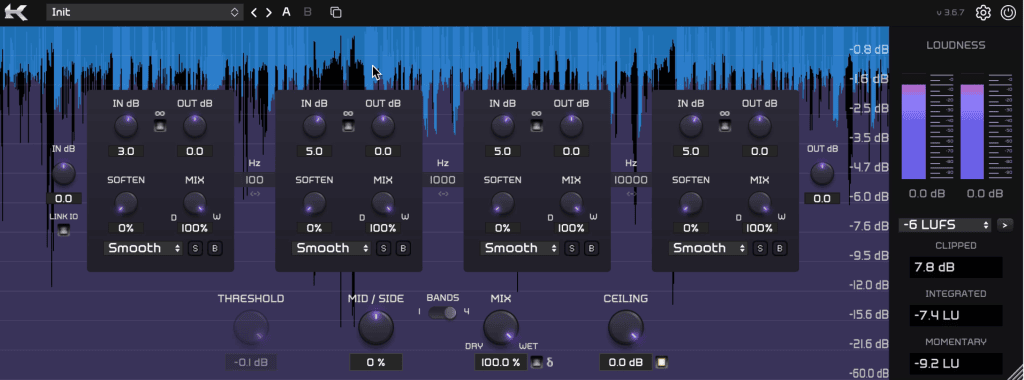
If you use KClip, here’s a control that you might have missed on first pass: the band switch.
By default, most people run a single-band clipper, which clips the sub-bass just as hard as the snare. But if you switch KClip into 4-band (multi-band) mode, you get way more control.
I like to back off the input drive on the lowest band (everything below 100 Hz), while leaving the higher bands pushed to hit my target LUFS. This softens up the clipper on the sub low end so your 808s stay clean, deep, and heavy while the rest of your drums get that punchy, aggressive clip.
2. The Traditional Limiter / Maximizer (iZotope Ozone)
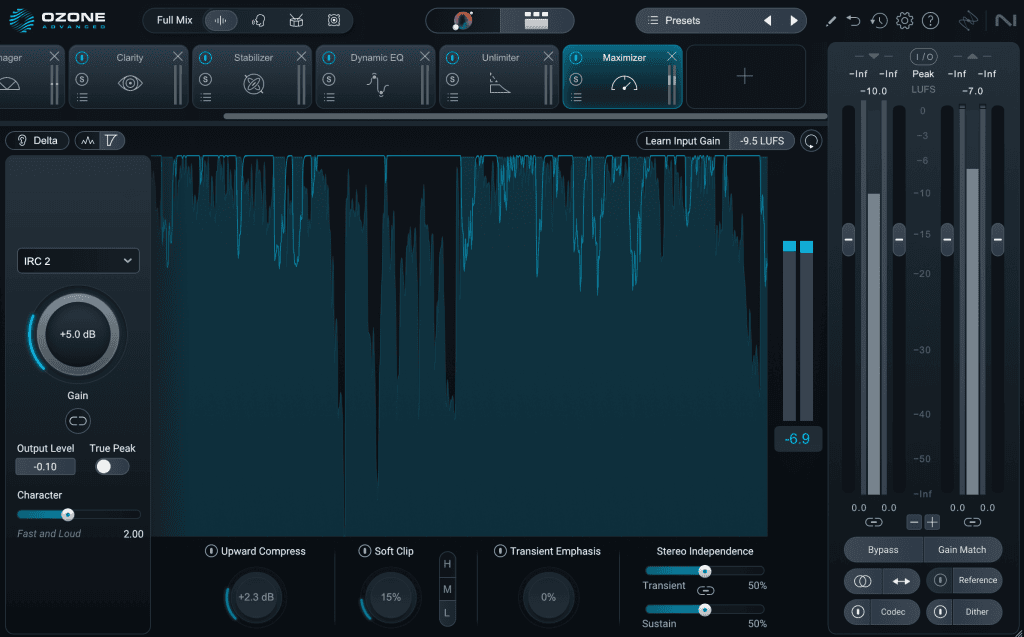
Now let’s talk about the limiter, or what most people call a “maximizer” these days (which is really just a limiter with extra features). For this, I love using the Ozone Maximizer.
Where a clipper chops the peak off, a limiter says: “Once the signal hits the threshold, let’s turn the volume down dynamically.” In simple terms, a limiter is just a compressor with a super high ratio.
Because it’s compressing instead of chopping, a limiter gives you:
- A smoother, cleaner low end (your sub-bass won’t break up or distort on big speakers).
- A more controlled, glued overall sound.
- Less aggressive transient bite compared to a clipper.
Quick Comparison: Clipper vs. Limiter
| Feature | Audio Clipper (e.g., KClip) | Audio Limiter (e.g., Ozone) |
|---|---|---|
| What it physically does | Slices off waveform peaks | Dynamically compresses volume spikes |
| Sound / Character | Aggressive, punchy, gritty | Smooth, clean, transparent |
| Primary Effect | Harmonic Distortion | High-Ratio Compression |
| Low-End Result | Aggressive, raw, distorted | Clean, deep, controlled sub-bass |
Which One Should You Use? (My Recommendation)
The question isn’t really whether you should use a clipper or a limiter, it’s about what your specific song needs.
- Need a raw, punchy, impactful, gritty mix? Lean on the clipper.
- Need a clean, open, controlled, commercial master? Lean on the maximizer (limiter).
Want the best of both worlds? Do what I do: Use both!
In my own sessions, I love running a clipper directly INTO a limiter.
By putting the clipper first, it tames those wild, fast transient peaks (like the initial smack of a snare) before they ever reach the limiter. Then, when the signal hits the limiter, it doesn’t have to react as heavily or pump as hard. You get all the punch and character from the clipper, combined with the smooth, clean volume control of the limiter.
Wrapping Up
I hope this cleared up the clipper vs. limiter debate for you! Give the hybrid chain a try in your next mixing session and see how it transforms your master bus.
Thanks for letting me be a part of your mixing and mastering journey. If you found this helpful, feel free to share it with another producer / engineer who might need it.
Talk to you soon, and stay blessed!